 Jan 13, 2026



 Jan 13, 2026
You’re running a growing MSP. Your tech stack looks solid. PSA, check. RMM, check. Dashboards, reporting tools, automation everywhere. Yet somehow, you’re still putting out fires, chasing status updates, and discovering problems only when clients escalate them. If this sounds familiar, you’re not alone. The issue isn’t about having the right tools. It’s about MSP operational control slipping through the cracks despite all that technology.
Here’s the uncomfortable truth: more tools don’t equal more control. And that disconnect is costing MSP owners, COOs, and service managers more than they realize.
Walk into any modern MSP, and you’ll find no shortage of technology. There are systems to track tickets, monitor endpoints, generate reports, and flag anomalies. On paper, everything points to a well-oiled operation. But ask the leadership team how they actually feel about their day-to-day operations, and the story changes.
Most MSP leaders manage through reports, tickets, and escalations. They review metrics in dashboards, respond to urgent Slack messages, and jump into situations only when something goes sideways. The tools tell them what happened, but they rarely show what’s happening right now or what’s about to go wrong.
This is the illusion of control. Having visibility into data is not the same as having control over operations.
Your dashboards are full of data. Ticket counts, SLA compliance rates, response times, technician utilization. All useful metrics. But here’s what they don’t tell you: which engineer is stuck on an issue right now, which client project is drifting off course, or where accountability is breaking down before it becomes a problem.
According to a Sophos MSP Perspectives 2024 report, 39% of MSPs cite keeping up with the latest cybersecurity technologies as their biggest day-to-day challenge. But the real challenge underneath that statistic? Not having a clear picture of what’s happening across their operations in real-time.
Managers find themselves reviewing metrics without understanding where to intervene. They see numbers shift but lack the context to make confident decisions.
The missing piece is decision visibility, not data visibility.
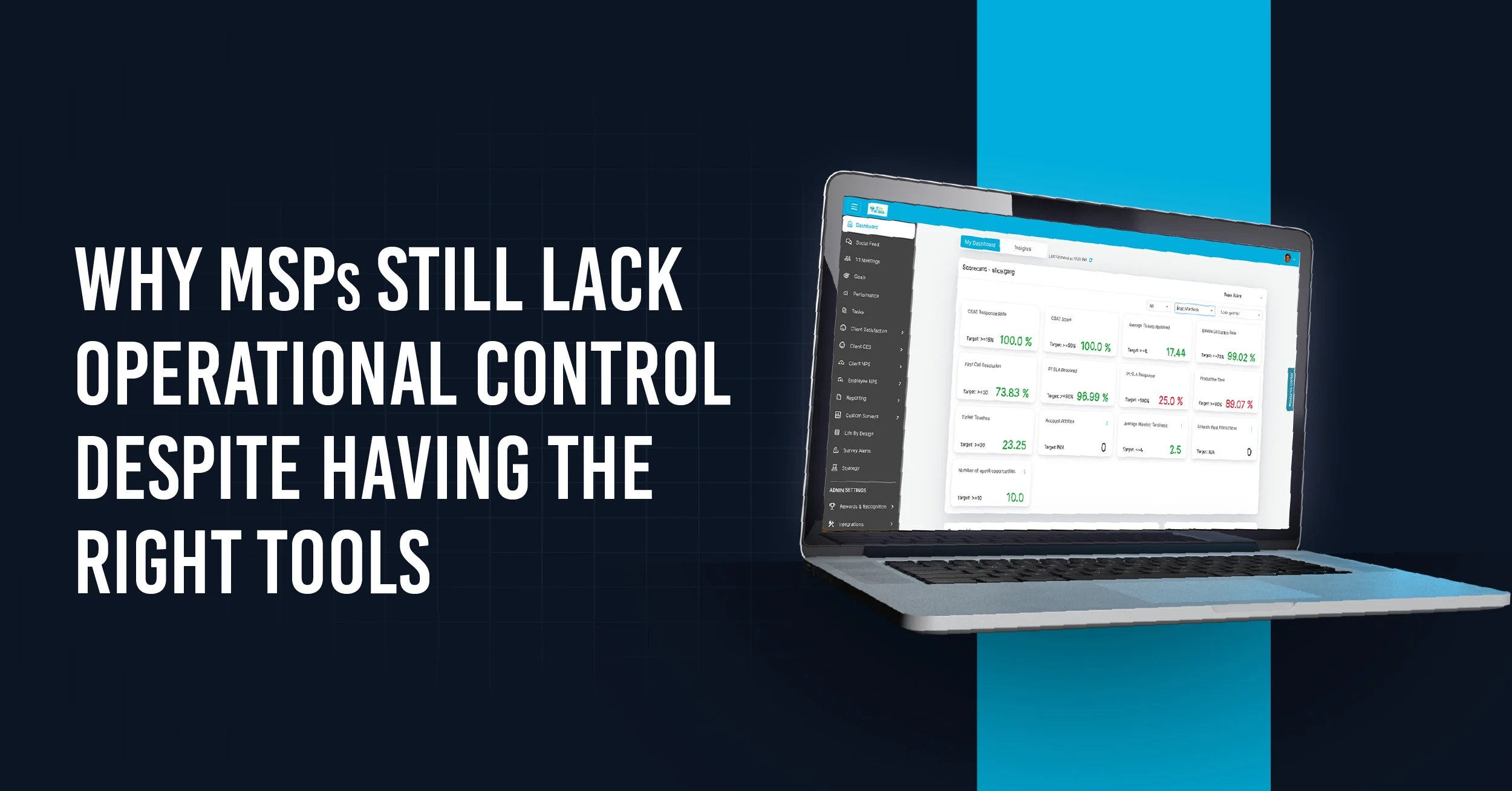
This is where solutions like Team GPS come into play. It’s designed as a visibility layer that sits above your existing tools to close the gap between data and control, giving MSP leadership the operational clarity they need without replacing what they already have in place.
Here’s how the pattern usually unfolds. A ticket comes in. It gets assigned. The technician works on it. Time passes. Nobody checks in until the client sends a follow-up email or the ticket breaches an SLA threshold. Only then does management get involved.
This isn’t a people problem. It’s a structural visibility failure.
Escalations, complaints, and urgency become the primary drivers of management behavior. Leadership spends their days responding to what’s already gone wrong instead of preventing issues from escalating in the first place.
Dashboards don’t prevent escalations. They report them.
The systems track activity, but they don’t surface risk signals early enough for managers to intervene meaningfully. This reactive loop becomes the default mode of operation. And once you’re in it, breaking out feels nearly impossible.
Real operational control for MSP leaders means knowing where your team’s attention is focused at any given moment. It means understanding who owns what, where bottlenecks are forming, and which situations need intervention before they spiral.
Operational control is the ability to answer these questions confidently:
Ask yourself this: Do we actually see this today, or do we only find out later?
If the answer is “later,” then you’re managing with reports, not with visibility. And that distinction matters more than most MSPs realize.
Let’s compare two versions of a service manager’s day.
Without operational control: The morning starts with email. Three client escalations overnight. One technician is out sick, and nobody knows which of his tickets need immediate attention. A project deadline is today, but the manager has no idea if it’s actually complete. The day becomes a series of status check meetings and Slack pings.
With operational control using Team GPS: The service manager opens a single view that shows real-time ownership signals across all active work. They can see which engineer is stuck, which client projects are at risk, and where accountability might be unclear. Instead of chasing updates, they intervene early on the two situations that actually need attention.
The difference? Visibility into operations, not just data about operations.
Early success signals look like this:
When MSPs shift from report-based management to visibility-driven management, teams operate more smoothly and leadership spends less time firefighting.
Let’s address the most common objection. If you’re thinking, “This sounds like another dashboard I won’t use,” that’s a fair reaction. MSPs are drowning in dashboards. Tool fatigue is real.
But here’s the distinction: A dashboard shows you what happened. A visibility layer shows you what’s happening and what needs your attention right now.
TeamGPS doesn’t replace your PSA or RMM. It sits above them. It exists to drive decisions, not generate more reports. The goal is operational clarity that leads to action, not more information to sift through.
Your PSA tracks tickets. Your RMM monitors devices. But neither tells you whether your team is functioning effectively right now or where you should focus your attention today. That’s what a visibility layer provides.
Let’s talk about what happens if you ignore this problem and just keep scaling with your current approach.
Problems compound silently. As you add more clients and grow your team, the complexity of your operations increases exponentially. What worked when you had 10 clients and 5 technicians breaks down at 50 clients and 20 technicians.
More tools don’t reduce noise. They increase it. Every new system adds another dashboard, another set of alerts, another login. Instead of gaining clarity, you’re drowning in fragmented information.
According to CompTIA research, 93% of organizations using managed services report improved operational efficiency. But here’s what that statistic doesn’t say: many MSPs themselves struggle with internal operational efficiency even while delivering it to their clients.
Control loss scales faster than revenue. You might be growing your client base, but if operational control is eroding, that growth comes at the cost of margin erosion, team burnout, and eventual churn risk.
Not every MSP needs to fix this right now. And that’s worth saying clearly.
This is NOT for:
This IS for:
If you’re reading this and thinking, “This is exactly what we’re dealing with,” then you’re likely in the right place.
Look for these signals:
These are symptoms of a control gap, not a people problem or a tool problem. And if they’re showing up consistently, it’s time to take action.
If you’ve made it this far, you probably recognize your own situation in these scenarios. The question now is simple: what do you do about it?
The best way to understand how operational visibility changes your MSP is to see it in action. Team GPS is built specifically for MSP leaders who want to regain control without adding more complexity to their operations.
See how Team GPS gives you operational control over your MSP.
Book a free Team GPS demo to walk through your specific challenges and see the platform in action. No sales pitch, just a clear look at how visibility drives better decisions.
Because at the end of the day, you didn’t build your MSP to spend your time chasing status updates and putting out fires. You built it to deliver exceptional service and grow sustainably. Operational control makes that possible.
A. MSP operational control is the ability to understand and manage your service delivery in real-time, knowing where risks exist, who owns what, and what needs attention before problems escalate to clients.
A. PSA and RMM tools provide data about what happened, but they don’t offer real-time visibility into what’s happening right now or where intervention is needed, leaving a gap between information and actionable control.
A. Dashboards aggregate historical data from your tools, while a visibility layer synthesizes operational context to show what’s happening now and what requires your attention, enabling proactive decision-making.
A. When leadership spends more time firefighting than strategizing, when client escalations could have been prevented with earlier visibility, or when scaling starts to feel chaotic rather than controlled.