 Jan 29, 2026



 Jan 29, 2026
MSP prioritization breaks down long before teams stop working hard. Most MSP leaders know the feeling. The week is packed. Tickets are closed. Fires are handled. But when Friday arrives, it’s hard to point to what actually moved the business forward. Strategic projects stall. Improvement work gets deferred. And the same issues resurface again and again.
This isn’t a motivation problem. It’s a decision problem. For MSP owners, COOs, and service managers, prioritization becomes harder as the business scales. Not because people care less, but because decision clarity erodes when everything feels urgent.
Most MSP leadership challenges don’t come from a lack of effort. They come from a lack of direction.
As MSPs grow past a few million in revenue, operational complexity increases faster than decision structure. More clients. More technicians. More tools. More requests. Without a clear way to separate urgent work from important work, priorities default to reaction.
This is the MSP prioritization trap:
Teams stay busy, but progress becomes unpredictable.
Urgency is easy to see. It arrives with alerts, escalations, and emotional pressure. Importance is quieter. It lives in project backlogs, improvement plans, and long-term risk reduction.
This creates a consistent imbalance in MSP decision making.
Reactive work feels unavoidable. Strategic work feels deferrable.
So, leaders make decisions based on what is loudest right now, not what matters most over time. Over weeks and months, this leads to missed SLAs, technician burnout, and stalled growth initiatives. This is not a discipline issue. It’s a visibility issue.
ost MSPs already track plenty of data.
Dashboards show ticket volume, response times, utilization, backlog size, and SLA performance. Reports are reviewed weekly or monthly. On paper, everything looks measured.
So why do MSP operational priorities still feel unclear?
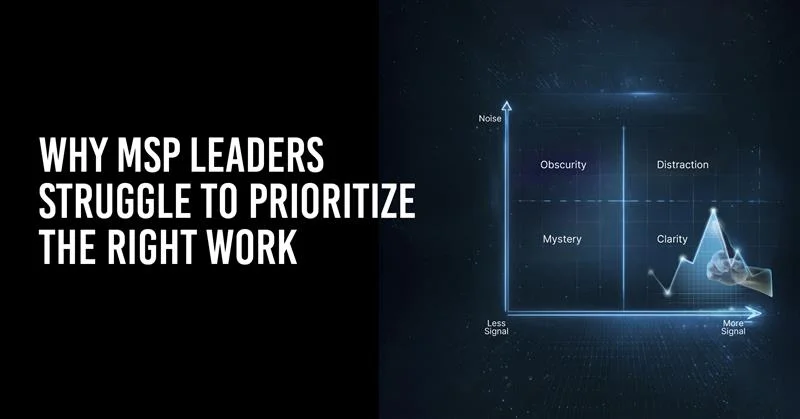
Because data shows what exists. It does not show what deserves attention today.
Seeing that 50 tickets are open does not answer which three represent the greatest risk if ignored for the next 48 hours. Metrics describe the environment, but they don’t provide decision clarity.
Service delivery prioritization requires three things data alone cannot provide:
Without those, prioritization remains reactive.
When MSP teams say everything feels like a priority, they’re not exaggerating. They’re describing the pressure created by unclear trade-offs.
When nothing is explicitly deprioritized:
In this environment, prioritization becomes implicit instead of intentional. Decisions get made by interruptions, not leadership.
This is where urgency vs importance becomes more than a theory. It becomes an operational failure mode.
Ownership gaps are one of the fastest ways to break decision making.
If you can’t clearly answer who owns the top operational risks right now, prioritization will stall. Tasks get discussed, revisited, and deferred. Leadership assumes teams are handling it. Teams wait for direction. Meanwhile, urgent work fills the vacuum because it comes with clear instructions.
Without visible ownership:
Closing ownership gaps is not about hierarchy. It’s about making accountability visible so decisions can move forward.
Most MSPs follow the same cycle. Work proceeds until an escalation, SLA breach, or client complaint forces leadership intervention. Resources get redirected. Priorities shift. Everyone scrambles.
This isn’t prioritization. It’s crisis response. The work that prevents crises rarely looks urgent. Proactive maintenance, client health monitoring, technical debt reduction; these activities don’t create alerts when they’re skipped. They create problems later.
That’s why MSP prioritization often becomes clear only after damage occurs.
Better MSP prioritization doesn’t come from more meetings or stricter ticket rules. It comes from clearer operational visibility.
Operational visibility means leaders can see:
Which risks are emerging, not just which issues already happened
Who owns each priority
When intervention still matters
When visibility improves, decision making shifts from reactive to intentional. Leaders can protect important work, make trade-offs explicit, and act before issues become externally visible. This is the foundation of effective service delivery prioritization.
If MSP prioritization is working, these questions should be easy to answer:
If answering these takes more than a moment, prioritization is likely being driven by circumstances instead of leadership.
High-performing MSPs don’t work on more things. They work on fewer things with greater clarity.
They separate noise from real risk. They make ownership explicit. They decide what will not get done this week. And they act while there is still time to influence outcomes.
Tools alone don’t create this maturity. Prioritization still requires leadership judgment, trade-offs, and accountability. But the right operational visibility can support that judgment by surfacing decision-relevant signals early and making priorities visible across the organization.
Some MSPs use operational visibility platforms to support this shift; systems designed to surface priority signals, clarify ownership, and highlight emerging risk before it escalates.
Team GPS is built around these principles to help leaders see what matters most right now, without relying on gut instinct or constant status meetings. Used well, it doesn’t replace leadership judgment. It supports clearer, more consistent prioritization as MSPs scale.
If you evaluate MSP prioritization through this lens, the real challenge becomes clear: you can’t lead what you can’t see clearly.